Case Study: Blended Fuel Program Rewrite (Initial + Annual Recurrent)
Role: Lead Instructional Designer (Program Architect • Content Developer • Project Manager • Stakeholder Liaison)
Authoring Tools: Articulate Storyline (Review/SME cycles supported through Articulate Review workflows)
LMS: Cornerstone (assignment logic and certification packaging managed in partnership with LMS admins)
Delivery: Blended Initial (CBT + OJT) + Annual Recurrent (microlearning-style CBT)
Overview
After a major airline merger, fueling operations expanded from a simpler fleet environment to a multi-fleet reality (2 → 6 fleets) across a broad station network. This created a costly training problem: at some stations, fueling agents servicing both legacy operations had to complete two separate training footprints—duplicative, time-heavy, and frustrating for vendors and learners.
I led an end-to-end rewrite of the fueling program to consolidate and modernize training while maintaining safety and compliance standards. The redesigned solution blended a fleet-agnostic Intro CBT, fleet-specific CBT modules assigned by station need, and structured OJT with performance tools. I also redesigned annual recurrent training from “retake the full initial program” to a short, data-driven Hot Topics module focused on situational awareness and recurring safety risks.

The Challenge
What needed to change
- Merger-driven complexity: Stations now supported a wider variety of aircraft types, increasing variability in fueling procedures and equipment interfaces.
- Duplicated training burden: Some learners were required to take both legacy training programs to be “covered,” increasing time and cost.
- Inconsistent training philosophy: One legacy program leaned heavily on CBT, while the other relied more on OJT—creating inconsistency in how competence was built and validated.
- Global readiness: International stations required a multilingual solution with careful translation and version control.
Who the learners were
Primary learners were fueling agents—mostly vendor-based, with some employee fueling teams at key hubs. The program needed to scale across 140+ stations and potentially thousands of learners (publicly stated here as “large-scale” due to lack of official publishable counts).
My Role
I served as the single-threaded owner for the project:
- Program architect: defined the new training structure and modular rules
- Lead designer/developer: built CBT modules and assessments in Storyline
- Project manager: managed timelines, dependencies, and phased releases
- Stakeholder liaison: aligned with safety/compliance, operations, vendors, and LMS partners
- Localization lead: coordinated translation vendor workflow and managed support resources to implement translated builds for functionality (text expansion, audio changes, layout fixes)
Discovery & Design Approach
1) Gap analysis (legacy-to-future state)
I compared the two legacy training footprints and identified that the biggest gap was delivery strategy, not the fundamentals of fueling: one program favored CBT-heavy instruction with limited OJT, while the other used a leaner CBT footprint with stronger reliance on OJT for real-world competence.
Design decision: adopt a structure closer to the leaner CBT + strong OJT model, while expanding safety content where it improved risk awareness.
2) A simple, scalable rule: fleet-agnostic vs. fleet-specific
To keep the curriculum both accurate and maintainable, I used a clear criterion:
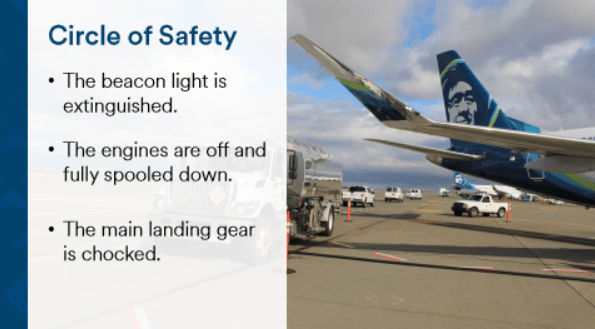
- Fleet-agnostic content: concepts not dependent on physically interacting with an aircraft type (e.g., documentation interpretation, general safety zones, situational awareness principles).
- Fleet-specific content: anything involving aircraft touchpoints and procedures (fuel panels, adapters, fleet-specific steps).
That rule became the backbone of the modular design and enabled smart assignment logic by station need.
The Solution
A) Initial Training Redesign (Blended Model)
1) Intro CBT (fleet-agnostic foundation)
I created an Intro CBT module containing universal fueling concepts applicable across fleets. This ensured every learner began with the same baseline expectations and safety framing before branching into fleet-specific requirements.
2) Fleet-specific CBT modules (assigned by station/fleet need)
Learners were then assigned only the fleet modules relevant to their station’s operation (e.g., Embraer, Boeing, Airbus variants). This reduced unnecessary seat time and eliminated duplicate effort.
I ran structured review cycles with SMEs to validate accuracy and improve instructional clarity during development.
3) OJT integration + performance validation tools
To ensure competence in real operational environments, the initial program included:
- OJT guides and structured practice expectations
- Trainer observation tools
- Fleet-specific performance rubrics
- Fleet-specific exams/knowledge checks
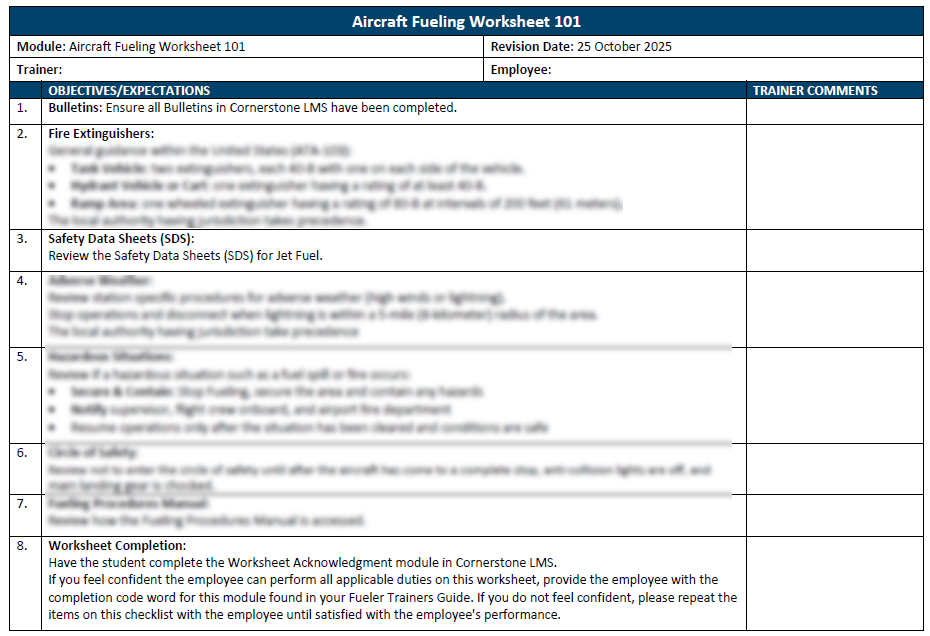
Practical worksheets were built to support consistent OJT execution and documentation at the station level.
4) Trainer communications and change enablement
To support rollout and adoption, I updated trainer-facing job aids and provided clear “what changed” communications (e.g., bulletins and updated resources) so trainers and vendor leads could quickly shift to the new model.
B) Globalization: Translation + Version Control
Because this program supported international operations, translation was designed in from the start:
- Partnered with a translation vendor to translate only the modules/languages needed based on operational coverage.
- Supported implementation work for translated Storyline packages (screen layout changes for longer text, revised audio/voiceover handling, and functional testing).
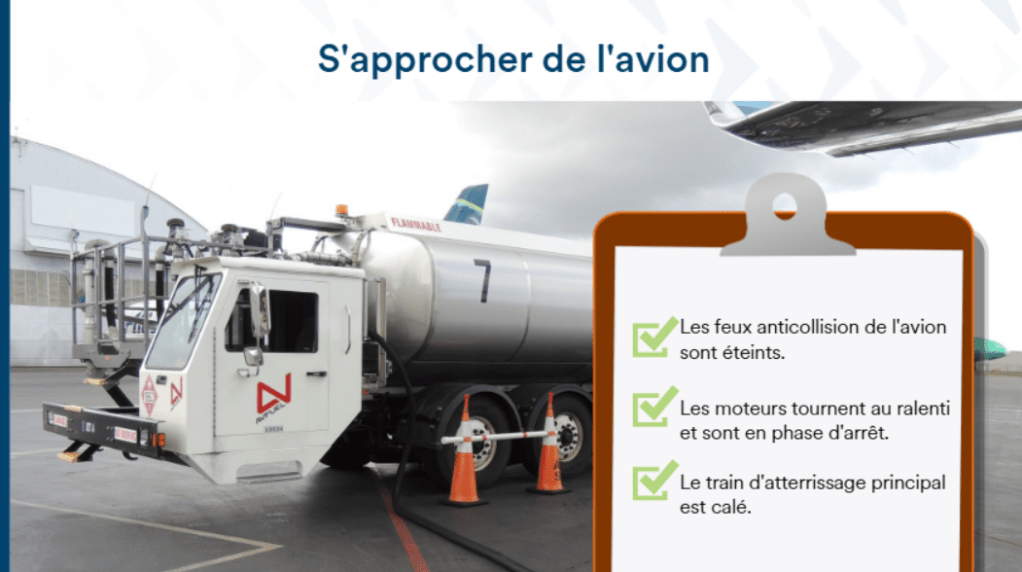
- Coordinated with LMS partners managing Cornerstone version control and assignment rules to ensure learners received the correct fleet/language certification package.
C) Annual Recurrent Redesign (Hot Topics Model)
The legacy annual recurrent model asked experienced fuelers to repeat large portions of initial training. Stakeholders wanted a recurrent approach that was:
- shorter and more engaging
- focused on real risk
- responsive to recurring incidents
Data-driven topic selection
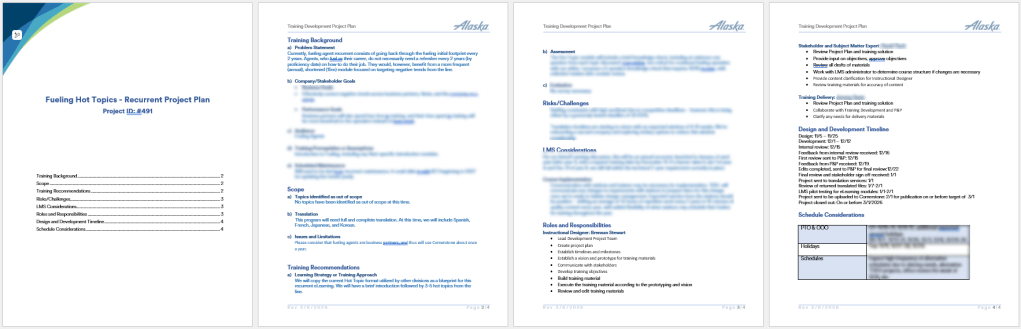
Instead of choosing topics by anecdote, I partnered with safety/compliance stakeholders to review incident reporting data and identify the most recurring fueling-related issue themes over the prior year.
From that analysis, I proposed and refined a set of Hot Topics focused on situational awareness and preventable repeat patterns (e.g., process adherence, verification steps, safety-zone behaviors, and common human-factor breakdowns). Stakeholder feedback helped consolidate and de-duplicate themes to ensure the final module was high signal, not broad coverage.
Results (Early Indicators)
Because training impact on safety/compliance outcomes can lag (time is needed to measure incident reduction), this case study highlights what was observable immediately after launch:
- Reduced training seat time and duplication by eliminating the need for dual legacy footprints and by assigning only relevant fleet modules.
- Improved learner/vendor sentiment (anecdotally) due to a more targeted and respectful approach to experienced learners—especially in the annual recurrent redesign.
- Strong stakeholder feedback on clarity, scalability, and alignment to real operational needs.
(Public note: formal compliance and incident trend outcomes require longer-term evaluation and are not stated here.)
Challenges & How I Handled Them
Challenge: working amid shifting merger priorities, competing deadlines, and manual revision/freeze cycles that affected what could ship when.
Approach: phased deliverables strategically—prioritizing the structural changes that reduced duplication first, while sequencing content maintenance and updates to align with documentation timing.
What This Project Demonstrates
- Program architecture at scale: modular design that stays maintainable across fleets and stations
- Blended learning design: right-sizing CBT while using OJT for performance mastery
- Global training delivery: translation planning + package engineering + LMS coordination
- Data-driven recurrent strategy: using incident trends to build targeted annual training
- End-to-end leadership: managing a complex initiative from analysis through deployment

